How to Check If an Online Discount Is Real (Fake MRP Explained)
That “80% off” tag may not be what it seems. Learn how inflated MRPs work in India and five quick checks to know if an Amazon or Flipkart discount is genuinely cheap.
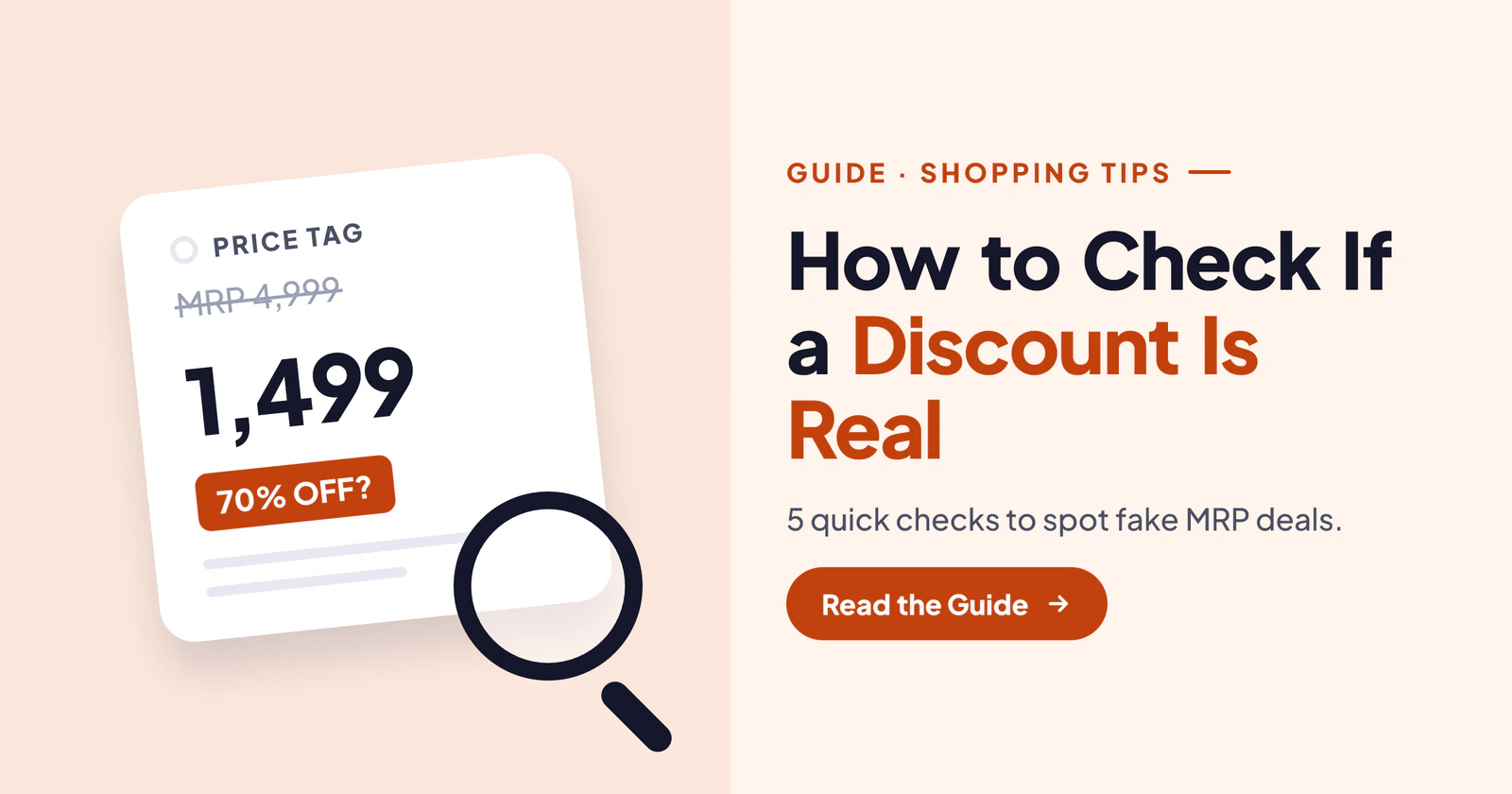
Open any shopping app in India and you will see the same thing: big red tags saying "70% off", "Lowest price ever" or "Deal of the day". Some of these are genuine bargains. Many are simply the normal price dressed up to look special.
We check hundreds of deals every week before posting them, and the single most common trick we see is an inflated MRP. In this guide we explain what that means, why it happens, and five simple checks you can do in two minutes to know whether a discount is real.
- A discount is only as honest as the MRP it is calculated from.
- The final price you pay matters more than the percentage on the tag.
- Comparing stores and watching the price for a few days beats any "sale" label.
What Is a Fake Discount in Online Shopping?
A fake discount is a price cut that looks large on screen but does not actually save you money compared with what the product normally sells for. The product itself may be fine — the problem is the number it is being compared against.
Every online discount in India is calculated from the MRP (maximum retail price). If a pair of earbuds has an MRP of ₹4,999 and sells for ₹1,499, the app shows "70% off". But if those earbuds have been selling for around ₹1,500 for months, you are not getting a deal. You are paying the usual price.
What does MRP actually mean?
MRP is the highest price at which a packaged product can legally be sold in India, and it has to be printed on the pack. It is a ceiling, not a fair or typical price. Nothing stops a brand from setting a very high MRP and then selling far below it every single day.
Why do sellers inflate the MRP?
Because big percentages sell. A shopper scrolling quickly is far more likely to tap "75% off" than a plain "₹999". Lesser-known brands do this most often, but even big brands can show "discounts" during sales that are smaller than they appear.
How to Check If a Discount Is Real: 5 Quick Checks
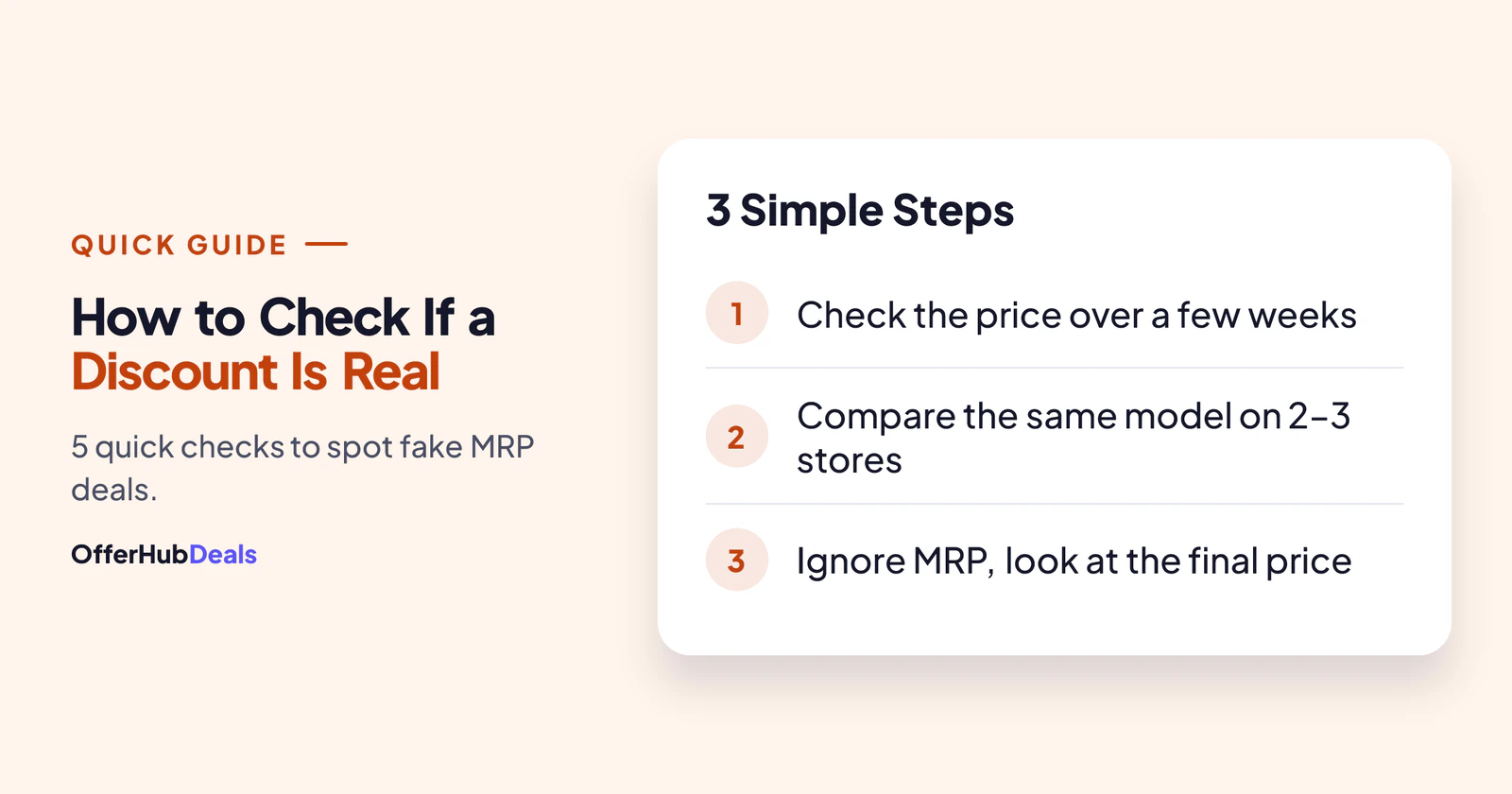
1. Look at the final price, not the percentage
Ask yourself one question: would I pay this amount if there were no discount tag at all? If the answer is yes and it is something you need, it is a reasonable buy. If the only thing pulling you in is "75% off", slow down and do the checks below.
2. Compare the same model on Amazon, Flipkart and one more store
Search the exact model name — "Sony WF-C710N", not "Sony earbuds" — on Amazon, Flipkart and a third store such as Croma or Tata CLiQ. If every store sells it for roughly the same price, the "discount" is just the market price.
On our deal pages, the Compare prices box under the Buy button does this for many products automatically, using Google Shopping data.
3. Watch the price for a few days
Add the product to your cart or wish list and check again after three or four days. Genuine price drops usually happen around sales, new model launches or stock clearance. If the price keeps returning to the same number, the "deal" is permanent.
4. Read the "Sold by" line and the return policy
One listing can have several sellers. The cheapest seller is not always the one you want. Check the seller rating, delivery promise and return window. Very low prices sometimes come with "no returns", which changes how good the deal really is.
5. Check coupons and bank offers separately
Sometimes the product price is ordinary, but an extra coupon or a bank card offer makes the final price genuinely low. Those savings are real because they come off what you actually pay. Our guide on stacking coupons and bank offers on Amazon explains how to combine them.
Real Discount vs Fake Discount: Quick Comparison
| Sign | Usually a real deal | Often a fake deal |
|---|---|---|
| Price history | Clearly lower than last week | Same price for months |
| Other stores | Cheaper than competitors | Same price everywhere |
| MRP | Close to launch price | Much higher than any real selling price |
| Reviews | Many detailed, recent reviews | Few reviews, or very short 5-star ones |
| Extra offers | Coupon or bank offer on top | Only the big percentage |
When Are Online Discounts Usually Genuine?
From what we see every week, these situations most often bring real price drops:
- Last year's phone or TV after the newer model launches.
- Big-brand electronics during festive sales like the Amazon Great Indian Festival and Flipkart Big Billion Days.
- End-of-season fashion clearance, when stores make room for new stock.
- Lightning deals with a short time limit and a price well below the usual.
Is Showing a Fake MRP Legal in India?
MRP labelling for packaged goods is covered by the Legal Metrology rules, and misleading price claims can count as an unfair trade practice under consumer protection law. If you feel a seller misled you, raise it with the store's customer support first. If that does not work, you can register a complaint with the National Consumer Helpline, run by the Department of Consumer Affairs.
How We Check Deals at OfferHubDeals
Before our team posts a deal, we compare the current price with what the product usually sells for, look at the reviews and check the seller. That is also why every deal page shows when it was posted — prices change quickly, and older deals may have ended. You can see the latest picks on Today's Deals and the biggest price drops on Loot Deals.
Final Word
Treat the discount percentage as a hint, not a promise. Check the final price, compare two or three stores, and give it a few days if you can wait. You will skip the fake bargains without missing the real ones.
Frequently asked questions
What is a fake MRP?
A fake or inflated MRP is a maximum retail price set much higher than the price the product normally sells for. It makes the discount percentage look bigger than the real saving.
Is a 90% off deal always fake?
No. Real 90% deals do happen, especially on clearance stock or small accessories. But check the final price, the reviews and other stores before you trust the percentage.
How can I see if the price really dropped?
Add the item to your cart or wish list and check it over a few days, and compare the exact model on two or three stores. If the price is always about the same, the discount is not special.
Where can I complain about a misleading discount?
Contact the store's customer support first. If it is not resolved, you can register a complaint with the National Consumer Helpline run by the Government of India.