



Discover the world's top Blogs
Search
Nothing Phone 4B Review | Should You Buy It or Not?

Nothing Phone 4B Review | Should You Buy It or Not?

720p display. IPS LCD panel. 4GB RAM. These are three things you never want to hear about a new phone — and the good news is the Nothing Phone 4B has none of them. This is Nothing's most affordable phone yet, part of a brand-new "B series" line, and I spent a full week using it as my daily driver. Here's my honest, point-by-point breakdown. Quick Summary 6.77" 1080p AMOLED display, 120Hz, hits 1,800 nits peak brightness Snapdragon 6 Gen 4 chip with 8GB RAM on the base model 50MP main camera with OIS, decent in daylight and indoors Massive 6,000mAh battery — Nothing's biggest ever — with 33W charging Starts at ₹29,999, with 3 years of OS updates and 6 years of security patches What's Good Bright, sharp AMOLED display with 120Hz and always-on support Genuinely loud, full-sounding dual stereo speakers Smooth day-to-day performance with no lag or crashes Huge 6,000mAh battery that easily lasts a full day Clean software with long update support and no ads What's Not No NFC, no eSIM in India, no microSD card slot Struggles with heavy games like Genshin Impact Haptics feel weak and need real attention to notice Camera detail drops noticeably when you zoom in Camera app occasionally fails to rotate the preview properly 1Design and Build Quality Unbox it and your first thought will probably be "this looks a lot like the Phone 4a Pro" — and you'd be right. Here's what stands out: Familiar design: Nearly identical back panel to the 4a Pro, but the dimple near the camera now lines up properly with the cutout Plastic unibody: No metal this time, but it still feels premium in hand, not cheap Weight: 210g — not the lightest, but it doesn't feel tiring to hold Glyph Lights: Five vertical LED squares instead of seven, but brightness and functionality are unchanged, and the red recording LED is still there Durability: IP64 rated for light splashes, Dragontrail glass on front, with a pre-applied screen protector in the box Colours: Blue, white, and black — blue is my personal favourite 2Display and Speakers This is where you'll spend most of your time, and Nothing hasn't cut corners: Panel: 6.77-inch, 1080p AMOLED with 120Hz refresh rate and an optical in-display fingerprint scanner Brightness: Hit 1,800 nits in testing — even higher than Nothing's official claim, and easily readable in direct sunlight HDR playback: Looks sharp and vivid on both YouTube and Prime Video Speakers: Proper dual stereo speakers that sound louder and fuller than you'd expect at this price, thanks to a dedicated top speaker grille instead of just the earpiece Bezels: Thinner on top and sides than the CMF Phone 3 Pro and Phone 3 Lite, though the chin is a touch thicker Extras: Always-on display included 3Performance A full week of daily use, and the phone stayed reliably smooth. Here's the breakdown: Chip: Snapdragon 6 Gen 4, paired with 8GB RAM even on the base variant Storage: 128GB or 256GB, UFS 2.2 with LPDDR4X RAM Benchmarks: Just above 1 million on AnTuTu Real-world test: Handled Android Auto, hotspot tethering, music, and app-switching over a 2-hour drive without heating up or slowing down Gaming: Steady 90 FPS in Call of Duty Mobile and BGMI; struggles with heavier titles like Genshin Impact Minor issues: Animations aren't quite as smooth as the 4a/4a Pro, and the camera preview occasionally doesn't rotate correctly — likely fixable with a software update 4Software Runs on Nothing OS 4.1 based on Android 16. Key points: Update promise: 3 years of OS updates and 6 years of security patches Clean experience: No ads, no lock screen clutter — just 3 uninstallable pre-installed apps (Facebook, Instagram, Amazon Music) Essential Voice: Converts speech into formatted text inside any app with a keyboard — long-press the Essential key to use it, and it can translate on the fly Glyph live activities: Track things like a Zomato delivery right on the Glyph strip Haptics: The weak point — vibrations are there but easy to miss, and cranking up the intensity makes them feel too harsh instead of better 5Camera A simple three-camera setup: 50MP main with OIS, 8MP ultrawide, and a 16MP selfie camera. Daylight: Punchy colours, well-handled HDR, genuinely pleasant photos Zoomed-in shots: Noticeably softer, with less fine detail Indoor shots: Surprisingly good in several test shots Night photos: Decent colour reproduction, but grain and softness appear once you zoom in Portraits: Skin tones could be better, though edge detection is solid Video: 4K at 30fps with rich colours, plus a dual capture mode for simultaneous front and rear recording, and decent walking stabilisation Verdict: Not the best cameras in this segment, not the worst either — solidly in the middle. 6Battery and Charging This is where the 4B genuinely stands out: Battery size: 6,000mAh — the biggest Nothing has ever fitted into a phone Real-world use: Comfortably lasts more than a day with normal use Screen-on time: Averaged around 6.5 hours in testing (Instagram, YouTube, gaming, photography) Charging speed: Up to 33W, taking about 1 hour 40 minutes from 20% to 100% 7Connectivity Network: No call drops or connectivity issues on either Airtel or Jio Included: Wi-Fi 6, Bluetooth 6, and support for nine 5G bands Missing: No NFC, no eSIM support in India, and no microSD card slot 8Nothing Phone 4B Price and Verdict Starting Price₹29,999 with launch offers For that price, you get 8GB RAM on the base model, a 1080p AMOLED display, a main camera with OIS, good stereo speakers, a huge battery, and strong software support. Final Verdict Is it the phone we would have dreamed of a year ago? Probably not. But in a genuinely tough year for budget and mid-range phones, this is a well-balanced device. Nothing seems to understand that cutting corners on the basics isn't the answer — it just makes a phone frustrating to use. Giving people a properly usable phone instead of just the cheapest one seems like the smarter move, and honestly, the only sensible one. 9Quick Specs SpecDetails Display6.77" 1080p AMOLED, 120Hz, always-on display ChipsetSnapdragon 6 Gen 4 RAM / Storage8GB RAM (base), 128GB / 256GB UFS 2.2 Rear Camera50MP main (OIS) + 8MP ultrawide Front Camera16MP Battery6,000mAh, 33W wired charging SoftwareNothing OS 4.1 (Android 16), 3-yr OS + 6-yr security updates BuildPlastic unibody, IP64, Dragontrail glass ConnectivityWi-Fi 6, Bluetooth 6, 9 5G bands, no NFC/eSIM/microSD PriceStarts at ₹29,999 10Frequently Asked Questions QDoes the Nothing Phone 4B support NFC or eSIM? No. In India, it skips NFC, eSIM, and a microSD card slot entirely. QHow long does the Nothing Phone 4B battery last? Its 6,000mAh battery comfortably lasts more than a day of regular use, averaging around 6.5 hours of screen-on time in testing. QIs the Nothing Phone 4B good for gaming? It runs Call of Duty Mobile and BGMI smoothly at 90 FPS, but heavier titles like Genshin Impact push it to its limits. It's not built as a dedicated gaming phone. QWhat is the Nothing Phone 4B price in India? It starts at ₹29,999 with launch offers. QIs the Nothing Phone 4B worth buying? Yes, if you want a bright AMOLED display, a big battery, decent cameras, and clean software without paying flagship prices — it's a solid, well-rounded pick in its segment.

Mobile
review
Best Upcoming Mobile Phones in July 2026 | Launch Date, Price & Specs

Best Upcoming Mobile Phones in July 2026 | Launch Date, Price & Specs

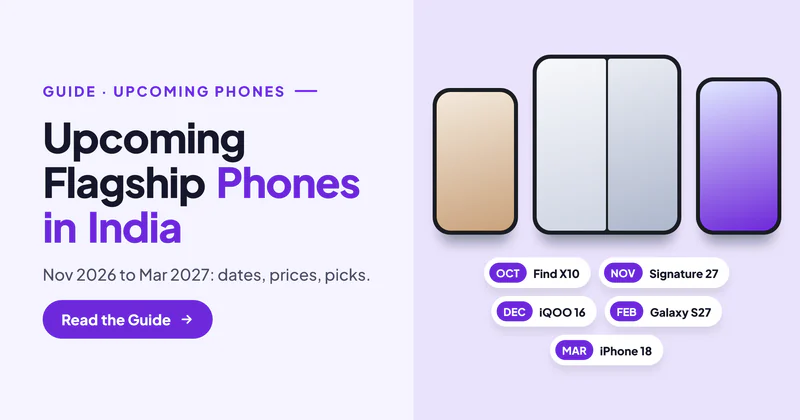
OnePlus, Samsung, Oppo, iQOO, Motorola, Infinix & Nothing — every major brand is dropping new phones this month. A detailed breakdown. If you've been holding off on a new phone, good news: the wait is finally paying off. After a fairly quiet stretch through April, May and June, July 2026 is shaping up to be one of the busiest launch months of the year. Nearly every major brand — OnePlus, Samsung, Oppo, iQOO, Motorola, Infinix and Nothing — has something landing this month, spread across almost every price bracket. Below is a complete, budget-wise breakdown of what's coming, what it's likely to cost, and what makes each one worth a second look. As always with pre-launch coverage, treat the pricing and specs as "expected" rather than final until brands confirm them officially — but based on how these things usually play out, most of what's listed here should hold up close to reality. 1Budget Phones Under ₹25,000 This is where the volume is, and July doesn't disappoint. OnePlus Nord N6 kicks off a brand-new budget series for OnePlus. Expect an 8,000mAh battery — a genuinely huge cell for this price bracket — running on Android 16 with Oxygen OS on top. It's expected to land in the ₹20,000–22,000 range, launching right around the start of July. Battery: 8,000mAh (massive for the segment) Software: Android 16 + Oxygen OS Price: ₹20,000 – 22,000 Launch: Early July Moto G77 brings a MediaTek Dimensity 6400 chipset paired with a 5,200mAh battery and a 108MP main camera. Motorola has priced its G-series competitively for years, and this one is expected to stay under ₹18,000. Look for it in the first or second week of July. Chipset: MediaTek Dimensity 6400 Camera: 108MP main sensor Battery: 5,200mAh Price: Under ₹18,000 Infinix Hot 70 Pro rounds out the sub-₹25K segment. It runs on a Dimensity 7100 chip with an HD+ IPS LCD display, a 6,000mAh battery, and 45W fast charging, priced around ₹20,000. For the specs on offer, this is shaping up to be one of the stronger value picks this month. Processor: Dimensity 7100 Display: HD+ IPS LCD Battery + charging: 6,000mAh, 45W fast charge Price: ~ ₹20,000 2Mid-Rangers ₹25,000 – 35,000 Step up a bit and the competition gets a lot more interesting. Samsung Galaxy M47 brings a 6.7-inch AMOLED display and a Snapdragon 6 Gen 3 processor, running Android 16 with One UI 8 on top. Samsung has already put out an Amazon teaser for this one, which is usually a solid sign the launch is close. Display: 6.7" AMOLED Chipset: Snapdragon 6 Gen 3 Software: Android 16 + One UI 8 Price: ~ ₹25,000 Nothing 4B slots in as the more affordable, understated sibling to the 4A series, priced around ₹25,000. Nothing has built its identity on distinctive design, and even at this price point, expect that to carry through. Design: Distinctive Nothing aesthetic Positioning: Affordable sibling to 4A series Price: ~ ₹25,000 Infinix GT50 Pro is aimed squarely at performance-focused buyers, running a Dimensity 8400 chipset with a 6,500mAh battery, 45W charging, and a 50MP camera. It's expected in the ₹30,000–35,000 bracket, launching slightly later in August rather than July. Chipset: Dimensity 8400 Battery: 6,500mAh + 45W charging Camera: 50MP main Price: ₹30,000 – 35,000 3Upper Mid-Range ₹35,000 – 50,000 This segment is where camera performance and chipset choice start to matter a lot more. Oppo Reno 16C launches on July 2nd with a Dimensity 7300 chipset, a 6,500mAh battery, and a 50MP telephoto sensor, priced around ₹35,000. The Reno series has always leaned into camera performance, and this entry is no exception. Chipset: Dimensity 7300 Battery: 6,500mAh Camera: 50MP telephoto sensor Price: ~ ₹35,000 Oppo Reno 16 sits above it at ₹45,000–50,000, with a newer-generation chipset, a 6,000mAh battery, a 55MP main camera, and a 50MP selfie camera. Notably, Oppo appears to be skipping the Pro and Pro Mini variants this time around, making the standard Reno 16 the flagship of the lineup. Chipset: Newer-gen processor Battery: 6,000mAh Camera: 55MP main + 50MP selfie Price: ₹45,000 – 50,000 iQOO Z11 is one of the more interesting launches in this range. After a long gap since the Neo series (it's been roughly six months, and a new Neo doesn't look likely), the Z11 steps in with a fast processor, 90W charging, and a massive 9,000mAh battery — a serious upgrade in battery capacity for the price. It's expected to launch under ₹30,000–35,000, with a 50MP Sony IMX882 sensor rounding out the camera setup. Processor: Fast (performance-oriented) Charging: 90W fast charging Battery: 9,000mAh (huge) Camera: 50MP Sony IMX882 Price: Under ₹30,000–35,000 Also worth watching: iQOO's S-series, which is reportedly making a comeback after six to seven years. This one is expected to focus more on selfie camera performance and premium design, priced around ₹45,000–50,000, with a launch expected in the third or fourth week of July. Focus: Selfie camera + premium design Price: ₹45,000 – 50,000 Launch: Week 3–4 July 4Premium & Flagship ₹50,000 and above July isn't just about budget and mid-range phones — several premium and foldable devices are lined up too. Motorola Edge 70 Max brings a newer flagship-grade processor, an AMOLED display, and Motorola's emphasis on durability. It's also expected to debut Motorola's new AI assistant, reportedly called Kira, though details on what it actually does are still thin. Processor: Flagship-grade Display: AMOLED AI: "Kira" assistant (debut) Price: ~ ₹50,000+ Motorola Razr (2026) continues the flip-phone lineup with a 6.96-inch foldable P-OLED display, a Dimensity 7450X-series chipset, and a 4,800mAh battery. Display: 6.96" foldable P-OLED Chipset: Dimensity 7450X-series Battery: 4,800mAh Price: ~ ₹75,000 (est.) Motorola Razr 70 Ultra goes further, with a 165Hz display, a Snapdragon 8 Elite processor, 16GB RAM, 512GB storage, and a 5,000mAh battery. As the top-tier Razr variant, expect pricing to land close to ₹99,000. Display: 165Hz refresh rate Chipset: Snapdragon 8 Elite RAM + Storage: 16GB + 512GB Battery: 5,000mAh Price: ~ ₹99,000 Samsung Galaxy Z Flip 8 is also expected this month, powered by an Exynos 2600 chipset — Samsung's newest in-house silicon. Chipset: Exynos 2600 Price: ~ ₹1.2 lakh (est.) Samsung Galaxy Z Fold 8 brings a 7.6-inch foldable AMOLED display with 16GB RAM and up to 1TB of storage, expected to be priced around ₹1.75 lakh. Display: 7.6" foldable AMOLED RAM: 16GB Storage: up to 1TB Price: ~ ₹1.75 lakh At the very top, Samsung Galaxy Z Fold 8 Ultra pushes things further with an even wider foldable display, expected around the ₹2 lakh mark — alongside a Z Flip 8 variant rumored to carry a 200MP main camera, an 8-inch inner foldable display, and a 6.5-inch cover display, also expected near ₹2 lakh. Display: Wider foldable Camera (rumored): 200MP main Price: ~ ₹2 lakh 📊 Quick Price-Wise Summary Under ₹25,000 OnePlus Nord N6, Moto G77, Infinix Hot 70 Pro ₹25,000–35,000 Samsung M47, Nothing 4B, Infinix GT50 Pro ₹35,000–50,000 Oppo Reno 16C, Reno 16, iQOO Z11, iQOO S-series ₹50,000+ Moto Edge 70 Max, Razr, Razr 70 Ultra, Z Flip 8, Z Fold 8 & Ultra ⏳ Should You Wait to Buy a Phone This July? With this many launches packed into a single month, it's a fair question. If your current phone is on its last legs and you need something now, don't wait indefinitely — there's always something new around the corner. But if you can hold out a few weeks, July's lineup covers nearly every budget, so it's worth waiting to see actual reviews and confirmed pricing before committing, especially in the ₹25,000–50,000 range where the competition is tightest this year. 📌 Frequently Asked Questions Which is the best budget phone launching in July 2026? The OnePlus Nord N6 stands out for its massive 8,000mAh battery, while the Infinix Hot 70 Pro offers strong value with fast charging and a big battery at a lower price point. Is the iQOO Neo series launching this year? It doesn't look likely. It's been around six months since the last Neo launch, and current reports point to the Z11 taking its place in this segment instead. When will the Samsung Galaxy Z Fold 8 launch? It's expected to launch in July 2026, alongside the Z Flip 8 and the higher-end Z Fold 8 Ultra, though Samsung typically confirms exact dates closer to the event. What is Motorola's new "Kira" AI assistant? Details are limited so far, but it's expected to debut with the Motorola Edge 70 Max as part of Motorola's push into on-device AI features. ⚡ All specs and prices are expected, not final. Stay tuned for official announcements.

Upcoming Phones
Mobile Launches India
July 2026
New Phone Launches