No Cost EMI Explained: Is It Really Free? (Simple Guide)
No Cost EMI sounds like free money, but there can be GST on interest and processing fees. Learn how it works on Amazon and Flipkart and when it actually saves you money.
"No Cost EMI available" appears on almost every phone, laptop and TV listing in India. It lets you split a big payment into monthly instalments without paying extra — at least that is the promise.
No Cost EMI can be a genuinely useful option. But it is not always completely free, and a few details decide whether it saves you money or quietly costs you a few hundred rupees. This guide explains how it really works, where the hidden charges are, and how to decide in one minute.
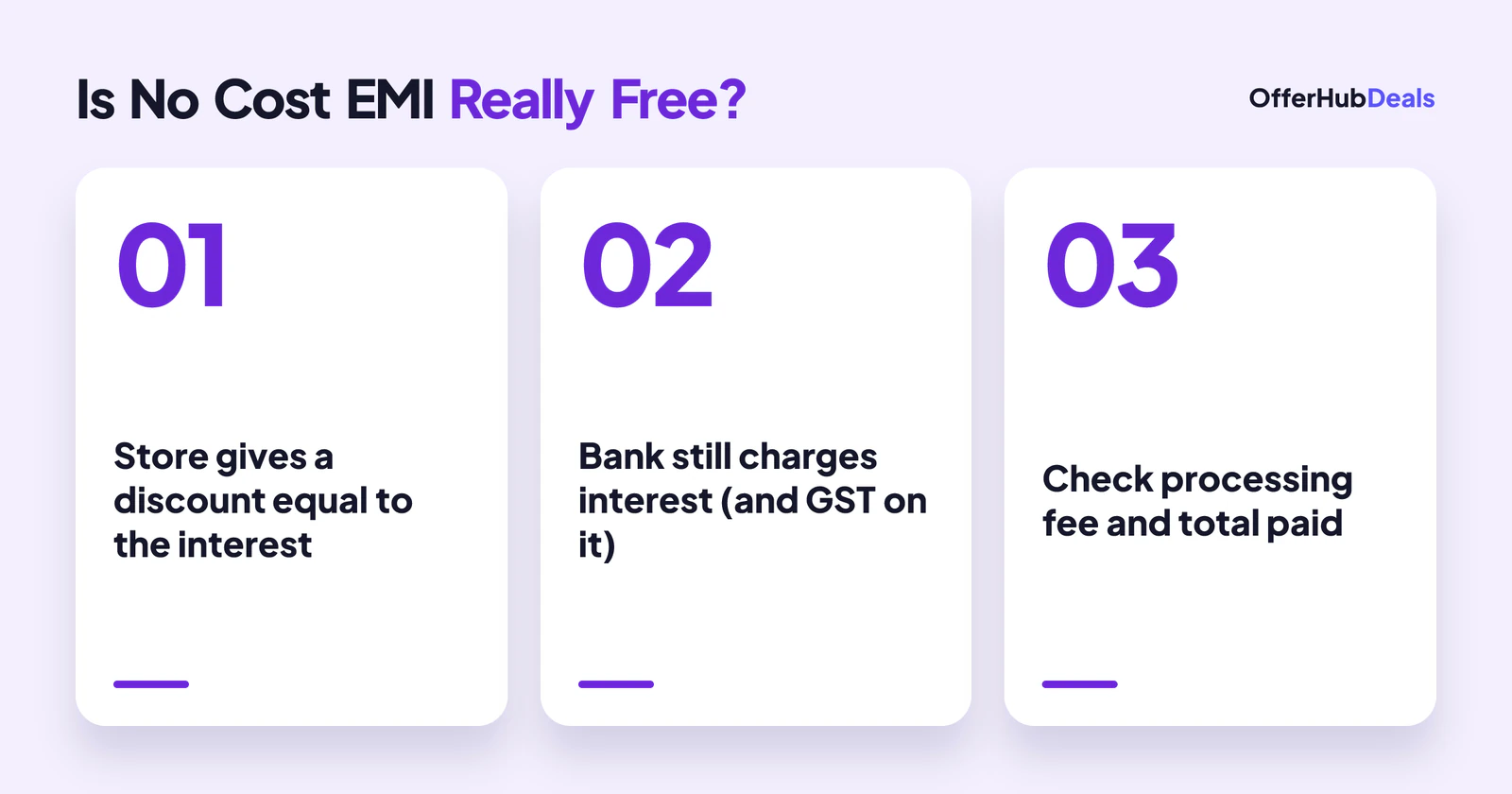
- The bank still charges interest; the store gives you an equal discount upfront.
- You may pay 18% GST on that interest plus a one-time processing fee.
- Always compare the total amount paid with paying in full after offers.
What Is No Cost EMI?
No Cost EMI is a way of paying for a product in equal monthly instalments where the interest is offset by a discount. You still take a short loan from your bank or card issuer, and that loan still has interest. The difference is that the seller or brand reduces the product price by the same amount, so your total comes back to roughly the original price.
How Does No Cost EMI Work on Amazon and Flipkart?
Here is a simple example. A phone costs ₹30,000 and you choose a six-month No Cost EMI. Suppose the interest for six months works out to about ₹1,200.
- At checkout, the store gives you ₹1,200 off, so the amount converted to EMI is ₹28,800.
- Your bank charges ₹1,200 interest over six months on that amount.
- Your six EMIs add up to about ₹30,000 — the original price.
You will see the discount and the interest shown separately in the price breakup on the checkout page.
No Cost EMI Hidden Charges You Should Know
GST on the interest
Banks charge 18% GST on the interest part of each EMI. In the example above, that is 18% of ₹1,200 — roughly ₹216 across the six months. Not huge, but not zero either.
Processing fee
Many banks charge a one-time processing fee for converting a purchase into EMI, often a few hundred rupees plus GST. It is usually listed in the EMI terms on the product page or on your bank's website.
Losing a bigger full-payment offer
This is the one most people miss. Sometimes the instant bank discount for full payment is larger than anything you save with No Cost EMI. If that ₹30,000 phone has a ₹2,000 instant discount for full payment, paying in full is clearly cheaper.
Foreclosure charges
If you want to close the EMI early, some banks charge a foreclosure fee, and you might lose part of the upfront discount.
Is No Cost EMI Good or Bad?
It is neither — it is a tool. Here is how we think about it.
No Cost EMI makes sense when:
- You need the product now and paying in full would stretch your monthly budget.
- There is no larger full-payment offer you would be giving up.
- Your card has enough limit, since the full amount is blocked on the card.
- You are confident you will pay every EMI on time.
Skip it when:
- A full-payment bank offer is bigger than the EMI benefit.
- You already have several EMIs running on the same card.
- The processing fee plus GST makes the total noticeably higher than the product price.
Does No Cost EMI Affect Your Credit Score?
Paying every instalment on time can help your credit history, just like any other loan repaid well. Missing an EMI brings late fees and interest, and can hurt your credit score. If money is tight, a shorter EMI you can comfortably afford is better than a longer one you might miss.
No Cost EMI vs Regular EMI vs Full Payment
| Option | Extra cost | Best for |
|---|---|---|
| Full payment | None | When a full-payment bank offer is big |
| No Cost EMI | GST on interest, maybe a processing fee | Planned big purchases without a better offer |
| Regular EMI | Full interest + GST | Only when there is no other choice |
What Does the RBI Say?
The Reserve Bank of India has in the past cautioned against "zero per cent interest" schemes that hide the interest inside the product price. That is why it is worth reading the price breakup at checkout, where the interest and the matching discount are shown. You can find the RBI's consumer awareness material on the RBI website.
Final Word
No Cost EMI is a helpful way to spread the cost of a planned purchase, not free money. Do the one-minute check, compare it with any full-payment offer, and time big purchases around festive sales when both EMI and bank offers are at their best — see our month-by-month guide to buying electronics.
Frequently asked questions
Is No Cost EMI really zero interest?
The bank still charges interest, but the store gives you an equal discount upfront, so the total is close to the product price. You may still pay GST on the interest and a processing fee.
Does No Cost EMI affect my credit score?
Paying every instalment on time can help your credit history. Missing an EMI can lead to late fees and hurt your credit score.
Can I get a bank offer with No Cost EMI?
Sometimes. Some bank offers apply to EMI and some only to full payment. Read the offer line on the product page before choosing.
Can I close a No Cost EMI early?
Most banks allow it, but some charge a foreclosure fee and you may lose part of the discount. Check with your card issuer.